

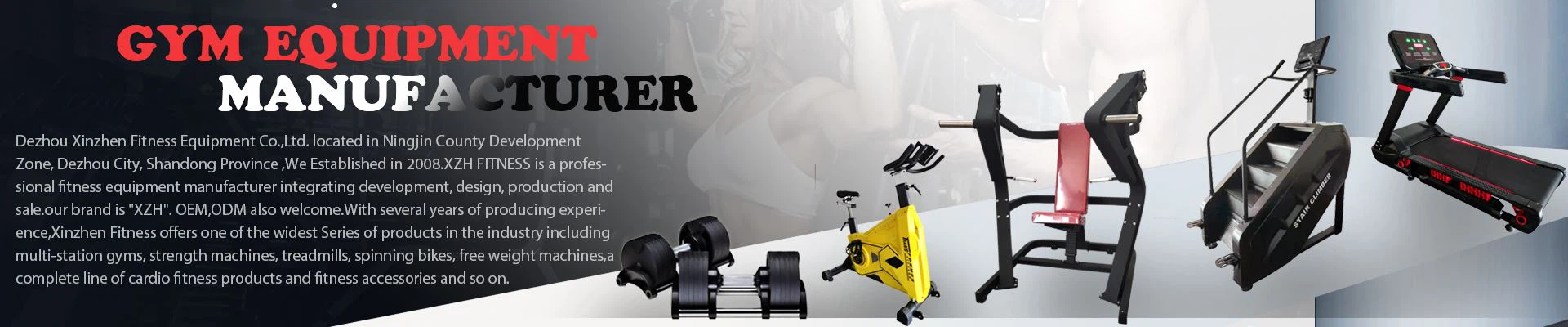


Established in 2008, Dezhou Xinzhen Fitness Equipment Co.,Ltd. is a professional manufacturer integrating development, design, production and sale of fitness equipment. Located in Ningjin County Development Zone, Dezhou City, Shandong Province, the company has established 5 workshops covering a total area of 50,000 square meters.
Rich Products
Based on Ningjin's well-developed hardware industry chain and complete fitness equipment production experience, Xinzhen Fitness develops and produces commercial treadmills, electric treadmills, club fitness equipment series, multi-gym machine, exercise bikes, comprehensive trainers, bars and dumbbells, etc. There are more than 600 varieties in seven series, including Gym equipment,aerobic series, multi-functional comprehensive fitness equipment, strength training equipment, home sports equipment, gym sports equipment, Available for gyms, corporate, universities, clubs and home use.
Strong Production Capability
Located in Ningjin County Development Zone, Dezhou City, Shandong Province, the company has established 5 workshops covering a total area of 50,000 square meters. Moreover, our professional team consists of 18 senior engineers and 80 experienced techs with rich experience in manufacturing fitness equipment, and we are equipped with advanced production machines, such as robot welding machine, laser machine, etc.
Product Application
Xinzhen Fitness is committed to providing high-quality and effective sports and fitness equipment for fitness clubs, fitness centers, government enterprises, education and training and other places. It has provided a complete set of fitness service solutions for more than 10,000 fitness clubs,gym, fitness centers, hotels, companies, government agencies, home gym ,academic rehabilitation and other application fields.
Leading Service
We have many years of industry experience, a complete production management, quality supervision, and sales service operation system. Whether you want to purchase Food Additive or Feed Additive, just email your requirements and we can customize the product for you.


What Is Rowing Machine?
A rowing machine can be used indoors to simulate the actions of rowing. On one end of the machine, there’s a seat and a foot bar with straps to secure your feet. The handle is attached with a cable to the flywheel at the front of the machine. Since a rowing machine weighs significantly less than a treadmill or an elliptical, you can easily move it around your home. A rowing machine provides both an aerobic and strength workout. It’s also a low-impact exercise, making it great for people who want to avoid overstressing their joints. You can use a rowing machine as your full workout or incorporate it alongside other exercises.
Benefits of Rowing Machine
Using a rowing machine as part of your fitness regimen provides numerous science-backed benefits. Here are several ways you may benefit from using this piece of gym equipment.
Enhances Aerobic and Muscle Strength
Indoor rowing helps improve muscular strength and cardiovascular endurance. The repetitive motion of the rowing stroke puts your muscles under stress to help your muscle fibers grow stronger. You also work your muscles and lungs to utilize oxygen effectively.
01
Increases Muscle and Joint Mobility
Rowing is a low-impact exercise that reduces the amount of stress put on your joints compared to other cardiovascular exercises. It also requires a wide range of motion that helps increase flexibility and minimize stiffness of your joints.
02
Offers a Full-Body Workout
Rowing also engages various muscle groups simultaneously, so it can serve as a comprehensive full-body workout that allows you to work out multiple areas of your body at once—specifically your legs, core, back, and arms.
03
Burns Calories
If you’re looking to lose weight, rowing can be an efficient way to burn calories. The combination of cardiovascular activity and resistance training makes it an effective tool for weight management and fat loss, all while being low-impact.
04
Improves Posture
Maintaining an adequate posture offers numerous health benefits—boosting your ability to breathe, aiding digestion, and preventing injuries. Rowing can be an effective workout that can enhance postural strength and awareness, potentially reducing the risk of back pain.
05
Hamstrings
The hamstrings are biarticular muscles, which means they control movement at two joints. The hamstrings extend the hip and flex the knee. The hamstrings are involved in flexing the knee from the recovery to the catch. At the catch, your knee is fully flexed so that your shin is parallel and your bent knees are up by your chest, so the hamstrings help bring your knees up. The hamstrings are activated during the drive phase of the rowing stroke to help extend the hip.
Quads
Like the hamstrings, the quads are biarticular muscles, but they are the antagonists of the hamstrings, meaning that the quads oppose the movement of the hamstrings. Whereas the hamstrings extend the hip and flex the knee, the quads flex the hip and extend the knee. The quads are the primary driver of knee extension during the drive phase of the rowing stroke, providing incredible propulsive power to press the body away from the footplates. Additionally, at the catch, the quads help flex the hip and bring your trunk forward so that you can maximize the length of your stride.
Glutes
The glutes are one of the primary muscle groups involved in the drive, helping extend the hip and move the trunk from the forward-leaning position to upright.
Calves
The calf muscles, or calves, are located behind the lower leg, running from the back of the knee down to where they taper and connect to the heel in the Achilles tendon. There are two distinct muscles that form the calves: the two-headed gastrocnemius, which is the larger and stronger muscle, and the soleus. The gastrocnemius helps bend the knee and plantarflex the ankle (like standing up on tiptoes), so the rowing machine uses the calves to help create ankle plantarflexion during the pressing portion of the movement from the catch to the finish. The soleus is a smaller, thinner muscle that lies underneath the gastrocnemius. It assists the gastrocnemius in plantarflexion of the ankle and stabilizes the tibia throughout the movement so that your shin and foot remain aligned with the knee, thigh, and hip. The gastrocnemius also helps control knee flexion, so the calves as a unit play a big role in the catch phase of the rowing stroke, helping create the knee flexion you need and the vertical shin position you are looking for.
Latissimus Dorsi
The latissimus dorsi is a large, broad, fan-shaped muscle that spans most of your back, and it is one of the primary muscles worked by rowing. During the catch phase of the rowing stroke, the latissimus dorsi helps control the extension of your arms.
Trapezius
The trapezius is a muscle in your upper back that helps control the movement of the shoulder blades, particularly retraction and protraction. During the catch phase, the trapezius muscle helps stabilize and control your shoulder blades as you extend your arms forward.
Rhomboids
Another group of muscles the rowing machine works is the rhomboids, which are smaller muscles in the upper back that connect the spine to the shoulder blades. The rhomboids are activated during the catch phase of the rowing stroke to help stabilize the shoulders as you reach forward with your arms to extend the length of your stroke.
Biceps
The biceps, which are the muscles on the front of your upper arms that people notoriously flex and pose with, are responsible for bending the elbow. During the drive and through to the finish, the biceps flex the elbow to help you pull the handlebar into your sternum, once your hands have passed your knees.
Triceps
The triceps, which are located in the back of the upper arm, are used to extend the elbow or straighten the arm. During the catch, your triceps extend your arms fully as you reach for the handlebar of the rowing machine and maximize the length of your stroke.
Abdominal Muscles
Rowing works the abdominal muscles like the rectus abdominis, internal obliques, external obliques, and transversus abdominis, a deep core muscle that encircles your entire trunk like a corset. For example, during the drive, the abs contract to stabilize your trunk as you hinge your hips backward. The abs are most heavily involved at the finish, where they play the vital role of supporting and stabilizing the trunk during the backward hip hinge against the resistance of the handlebar.
Erector Spinae
The erector spinae and deeper multifidus muscles run along the length of the spine, where they help extend and stabilize the spine. These back muscles worked by the rowing machine engage during numerous phases of the rowing stroke. For example, during the drive, the erector spinae group helps stabilize the upright position of your torso as you pull the handlebar in towards your lower ribs. During the catch, these muscles help stabilize the trunk even though you are hinging forward, preventing collapse or rounding of your back.
How to Use a Rowing Machine


There are four phases to the rowing stroke: Catch, drive, finish, and recovery. Each phase requires a different set of muscles to complete the movement. Follow these steps to perform one proper rowing stroke:
The Catch
This is the start of the rowing motion where the seat is slid all the way forward and you bend your knees close to your chest so you're close to the front of the machine. During the catch motion, you'll strengthen your triceps since they are used to extend your arms forward. You'll also utilize your hamstrings, glutes and calf muscles which compress as your shins are held in a vertical position. Your back muscles, specifically the latissimus dorsi, are activated during the catch.
The Drive
The next phase of the stroke starts with pushing your feet off the foot stretchers until your legs are fully extended, engaging your core and using your hip hinge to swing your body into an upright position. Then, engage your shoulders, arms and back to pull the handlebar back. The drive is one swift fluid motion and strengthens your legs, shoulders, biceps, abs, and back.
The Finish
This third phase requires core engagement as you stabilize your body while hinging slightly backward. Then use that momentum to fully extend your legs and bring the handle all the way into your sternum. Each muscle in your torso is activated here to stabilize the body, as well as the biceps.
The Recovery
The final motion of the rowing stroke is essentially all of the first three steps in reverse. You'll strengthen your triceps as they activate to extend your arms forward, as well as your upper legs and calves as they contract during the recovery motion. Each of the four phases also utilizes the muscles in the neck, hands and chest.
Things to Consider When Buying Rowing Machines
Size and Maneuverability
Measure the space where you intend to put the rower, both during use and for storage. Measure for accuracy and compare your measurements to the manufacturer’s specifications of the product you’re interested in. If you need to store the machine out of sight or in a different location when you’re not exercising, look for folding frames or vertical storage solutions. Additionally, consider the weight of the machine and whether or not it has transport wheels. Some rowing machines are designed to be assembled and left where they are, for the most part, while others have purposeful designs that allow them to be easily transported.
Ease of Use and Setup
Before buying any cardio machine, it’s a good idea to try and find the assembly instructions and owner’s manual online. This will give you a good idea of how difficult or easy it is to set up the machine and how much time you’ll need to budget for that. Pre-reading the owner’s manual lets you know how much maintenance the machine requires so you can decide whether or not you’re able to commit to it.
Resistance Mechanism
There are three main types of rowing machines: air rowers, water rowers, and magnetic rowers.
- Air rowers have fewer components and generally don’t have defined resistance levels. Instead, they feature a damper that alters the influx of air to increase or decrease resistance. The user’s effort level largely influences the resistance, too: The harder you pull, the more air enters the flywheel, and the harder the rowing stroke feels. These models are relatively noisy, considering that the flywheel is practically a big fan.
- Magnetic rowers utilize metal flywheels with magnets to alter resistance. When you change the resistance level on a magnetic rower, the magnet in the flywheel casing gets nearer or farther away from the metal flywheel, effectively creating a change in the resistance. The closer the magnet is to the flywheel, the more challenging the resistance.
- Water rowers use a fan flywheel in a tank of water to create resistance. Like air rowers, the resistance on a water rower is largely user-dependent. Some water rowers have dampers but, generally, the harder you pull, the more resistance you’ll create. Also, you can alter resistance by changing the water level in the tank. More water means more resistance.
Resistance Levels
Technically speaking, only magnetic rowing machines have defined resistance levels. Air rowers and water rowers are more likely to have a damper setting. Simply put, the damper changes the resistance. At a minimum, look for eight resistance levels on a magnetic rowing machine. The more levels available to you, the more room there is for progression. The standard on air and water rowers is a damper with 10 settings.
Design and Comfort
Consider ergonomics when shopping for a rowing machine. The seat height is one very important factor that is often overlooked. A low seat height makes it more difficult to sit down on the machine and get up. A 20-inch seat height is considered ideal for mobility purposes, but it’s common to see lower seat heights on lower-cost machines. Additionally, don’t forget to check for features like seat contour and seat padding, adjustable foot pedals and straps, and a padded handlebar, if those features are important to you.
Metrics Monitoring
Many rowing machines come equipped with monitors that track metrics like time, distance, strokes, heart rate and calories burned. Consider whether these features are important to you and if the monitor is user-friendly and provides the data you need. Even budget-friendly models provide basic metrics, but high-end models can dive deeper into the numbers to deliver additional insights.
Warranty
You should look for a warranty of at least five years on the frame and one year for parts. Higher-end models may offer longer warranties. Budget rowing machines typically have shorter warranties, with some not offering a warranty at all.
Frequently Asked Questions
Q: What is Rowing Machine?
Q: Does a rowing machine help lose belly fat?
Q: What muscles do Rowing Machines work?
Q: What type of rowing machines are best for home use?
Q: Are rowing machines suitable for beginners?
Q: How do I properly use a rowing machine?
Q: Who shouldn't use Rowing Machines?
Q: How to avoid getting injured using a Rowing Machine?
Q: Can you lose weight using a Rowing Machine?
Q: Is a rowing machine a good workout?
Q: Can you get in shape by just rowing?
Q: How long should you do a rowing workout?
As one of the most professional rowing machine manufacturers and suppliers in China, we're featured by quality products and competitive price. Please rest assured to buy cheap rowing machine for sale here from our factory. Contact us for customized service.
Air Rowing Machine Biggest Wind Resistance, Magnetic Rowing Machine, Wood Water Rower Commercial Rowing Machine